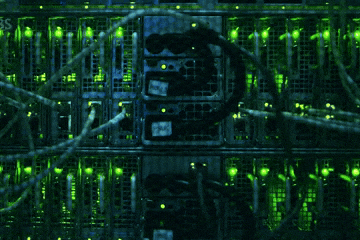
The satellites feature advanced AI capabilities, up to 100 Gbps laser inter-satellite links and remote sensing payloads — data from which will be processed onboard, reducing data transmission requirements. One satellite also carries a cosmic X-ray polarimeter developed by Guangxi University and the National Astronomical Observatories of the Chinese Academy of Sciences (NAOC), which will detect, identify and classify transient events such as gamma-ray bursts, while also triggering messages to enable followup observations by other missions. […] The company says the constellation can meet the growing demand for real-time computing in space, as well as help China take the lead globally in building space computing infrastructure, seize the commanding heights of this future industry. The development could mark the beginning of space-based cloud computing as a new capability, as well as open a new arena for strategic competition with the U.S. You can watch a recording of the launch here.
🧅
All theoretical chemistry is really physics; and all theoretical chemists know it. — Richard P. Feynman